

Brazil's lower house approves main text of government's new fiscal rules
Brazil's lower house approved on Tuesday the main text of the new fiscal framework proposed by President Luiz
2023-08-23 07:49

UK pay deals cool for first time in 2023, easing pressure on BoE: XpertHR
LONDON Pay deals awarded by British employers cooled for the first time this year in the quarter to
2023-08-23 07:24

Newly released video shows police shooting into vehicle at a traffic stop in an encounter that contradicts initial police narrative
An attorney representing the family of a 27-year-old man who was shot and killed by a Philadelphia police officer last
2023-08-23 07:18

Lawsuit seeks to halt Medicaid terminations in Florida
Two consumer advocacy groups filed a lawsuit in a Florida federal court Tuesday seeking to halt the state's termination of residents' Medicaid benefits. The suit is the first in the nation to challenge states' resumption of reviewing Medicaid enrollees' eligibility and dropping those deemed no longer qualified.
2023-08-23 07:16
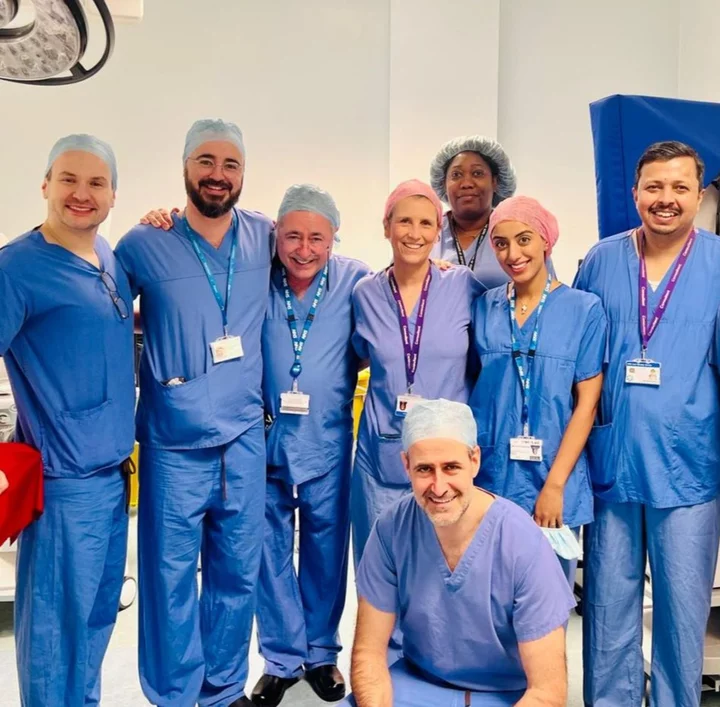
How did surgeons carry out Britain’s first womb transplant?
Surgeons worked all day and into the night to ensure Britain’s first womb transplant went smoothly. Its success is down to meticulous research, years of sharing knowledge between experts around the globe, and the hard work and dedication of doctors Professor Richard Smith, from Imperial College London, and Isabel Quiroga, from the Oxford Transplant Centre. Around 50 babies have been born worldwide as a result of womb transplants, which give women missing a functioning uterus a chance to have a baby. In the first UK case, the operation to remove the womb from the recipient’s 40-year-old sister lasted eight hours and 12 minutes, with surgeons leaving her ovaries behind to prevent pushing her into early menopause. One hour earlier, surgeons began operating on the 34-year-old recipient, preparing her body to receive the donated organ. This operation lasted nine hours and 20 minutes, with the surgical team experiencing some difficulties including a higher-than-expected blood loss of two litres. However, after just 10 days, the recipient was well enough to leave the hospital and has continued to have a good recovery. She is also having regular periods, which shows the womb is working well. Her sister was discharged five days after her donor operation and has also made a good recovery. Removing a womb is a similar operation to a radical hysterectomy, according to Prof Smith, who as well as being a gynaecological surgeon is the clinical lead at the charity Womb Transplant UK. He and Miss Quiroga led the team of more than 30 staff who worked on the transplant one Sunday in February. Prof Smith and Miss Quiroga removed the older sister’s womb, cervix and fallopian tubes, plus crucial blood vessels around the organ. The main vessels are the uterine arteries running into the womb, but the surgeons also aimed to collect some of the larger internal vessels that lead into the smaller branch of the womb. Prof Smith said surgeons doing these operations have to retrieve veins involved in the drainage of the womb. “One of the amazing things is that my surgical skill-mix as a cancer surgeon is to remove organs with a margin of normal tissue, while sealing the vessels as I go,” he said. “Transplant surgical skills are different – that is to remove a normal organ with the best number of non-sealed vessels as you can. “Isabel and I operate together with no ego – it just flows backwards and forwards across the table.” He added: “The day itself was truly humbling. We turned up at 7am at the Churchill transplant centre with the donor and the recipient families, then we went into a pre-op huddle. Those in the huddle included surgeons, nurses, anaesthetists and technicians. Prof Smith and Miss Quiroga worked to remove the womb, before the organ was prepared for transplantation by a “back table” team. “This was an organ which had a very, very unusual blood supply,” Prof Smith said. “In fact, it had a set of blood vessels which I’ve never seen in my entire career. They made my dissection a bit harder than it might have been, but we got there.” In the theatre next door, one hour before the retrieval of the womb was completed, surgeons began to operate on the donor’s younger sister to enable her to receive the womb. Prof Smith and Miss Quiroga switched from donor to recipient and Prof Smith removed the vestiges of the underdeveloped womb the recipient was born with. Meanwhile, the organ was packed and transported between the two theatres under sterile conditions to prevent contamination. A sterile bag with a cold perfusion solution contained the womb, which was then placed into a container with ice. During surgery, ligaments attached to the womb were attached to the recipient to help the womb stay in a relatively fixed place so it does not move around the pelvis. The most important part of the transplant operation was the joining of the very small vessels that give the blood supply to the womb. This was the most delicate and difficult part of the operation and was led by Miss Quiroga. Once all the vessels were connected, the donor’s vaginal cuff – around a 1cm part – was stitched into her sister’s vagina. If and when the recipient is able to complete her family, the womb will be removed six months later to prevent her from needing immunosuppressants for the rest of her life. Prof Smith said: “We know that the chance of failure at the point where the uterus goes in – if you look at the world literature – is 20 per cent to 25 per cent. And that failure is usually on the basis on sepsis and thrombosis. So technically, we are up to the job, but what happens thereafter can be scary. “Once you get to three or four days later, the chance of failure drops to probably less than 10 per cent. “Once you get to two weeks – and at the point where the woman has a period – the chance of her having a baby at that point is very high and the chance of failure has dropped to low. But those first two weeks – it’s very scary as a surgeon to watch and wait.” Biopsies to check the womb was functioning were read in London but then also confirmed by an expert team in the US at Baylor University Medical Centre in Dallas, where other womb transplants have been performed. Prof Smith said the procedure gives new hope to women born with devastating conditions. He said: “You’ve got girls, maybe 14, who have not had periods, they go to the GP and a scan shows there is no uterus. Absolute catastrophe. “Up until now, there’s been no solution for that, other than adoption or surrogacy... That’s not the case now. It’s really exciting.” On whether transgender women may also benefit from the operation, Prof Smith said that was still a long way off. He said the pelvic anatomy, vascular anatomy and shape of the pelvis are different, and there are microbiome issues to overcome. “My own sense is if there are transgender transplants that are going to take place, they are many years off. There are an awful lot of steps to go through. My suspicion is a minimum of 10 to 20 years.” Miss Quiroga said the living donor programme to date in the UK has focused on women with relatives who are willing to give their wombs. “It will come to a point where we will have friends or altruistic donors, like we have with many other transplants, but at the moment we’re only focused on people who have come forward with relatives,” she said. Read More Bursts of activity that make you huff and puff ‘linked to reduced cancer risk’ Fiona Phillips, 62, reveals she has Alzheimer’s disease Woman has all her teeth removed after rare vomiting condition causes them to fall out Bursts of activity that make you huff and puff ‘linked to reduced cancer risk’ Fiona Phillips, 62, reveals she has Alzheimer’s disease Woman has all her teeth removed after rare vomiting condition causes them to fall out
2023-08-23 07:16

Immortals of Aveum Length: How Long to Beat?
The battle to defend Aveum begins now, but how long will it take?
2023-08-23 06:52

6 Legendary Beings Who Haunt America’s National Parks
The parks offer thrill seekers, ghost hunters, and the brave alike another reason to visit.
2023-08-23 06:30

Father of NFL player Caleb Farley dead after explosion at North Carolina home
The father of Tennessee Titans cornerback Caleb Farley has died after an explosion and collapse of a North Carolina home that injured one other person, according to authorities.
2023-08-23 05:59

25 Best Aaron Rodgers Fantasy Football Names For 2023 NFL Season
The best Aaron Rodgers fantasy football names for the 2023 NFL season.
2023-08-23 05:54

Rumer Willis reveals her daughter’s name was inspired by typo in a text
Rumer Willis has revealed that the name for her daughter, who she welcomed in April, was actually inspired by a text typo. The actress, 35, spoke candidly about her daughter, who she shares with boyfriend Derek Richard Thomas, during a recent interview with People. Willis went on to explain that while her daughter goes by Louetta, that wasn’t the name that she and Thomas had initially planned. “We were thinking about the name Loretta, and it was a typo,” she said. “Her dad and I were texting, and he left the ‘R’ out of Loretta, and it was just Louetta.” Willis - the daughter of Bruce Willis and Demi Moore - added that, after her partner made the typo in his text, she came to realise that she liked the name “Louetta” better than “Loretta”. “I was like: ‘Oh, I love that!’ I feel like it was one of those kind of divine intervention universe moments, and we figured it out actually quite early in my pregnancy,” she explained. However, according to The House Bunny star, she initially had a few concerns about if the name would be the best fit for her daughter. “What was scary was, I love this name, but oh man, is it going to be her name? Is it the right name?” she continued. What if she comes out and doesn’t look like this?” Despite her mixed feelings about the name during her pregnancy, Willis said she realised that she wanted to call her baby “Lou” once she was born. “I fell in love with the name so much, so early on, that I was then worried that it wouldn’t work,” she said. “But then she came out, and I mean, to me, at least right now, I was going to name her Lou, whether she was a boy or a girl.” She also added that both she and Thomas wanted to pick a name that had some “versatility” to it, before describing some of the different nicknames that her daughter could choose to go by. “If she doesn’t feel like a Louetta, she can go by Lou, she can go by Etta,” she said. “She can go change it up throughout her life. Whatever she wants.” Earlier this year, Willis took to Instagram to announce the birth of her first child. “Louetta Isley Thomas Willis. You are pure magic,” she wrote in the caption, alongside a snap of her then-newborn. “Born at home on Tuesday April 18th. You are more than we ever dreamed of.” Along with opening up about her baby’s name, Willis has also taken to social media to speak candidly about her experiences as a mother. Earlier this week, she hit back at criticism on Instagram after she shared a photo of herself breastfeeding her daughter. When Instagram users questioned her for sharing the selfie, with claims that she posted it “for attention,” the actress expressed how she viewed the ability to feed her daughter as a “privilege,” and accused critics of holding “a limited view of” breastfeeding. She continued defending her decision to post the photo, explaining how she wanted it to lessen the “shame” that women face. “I think it’s incredibly important to share because there is an incredible amount of shame that comes with being born into a female body,” Willis wrote. “And I want to lead by example in teaching my daughter that she doesn’t have to be ashamed of her body ever and that she can decide how she wants to share it.” Read More Rumer Willis shuts down criticism over breastfeeding photo with her child: ‘I am the happiest I have been’ Rumer Willis says she is ‘grateful’ to her body following birth of daughter Bruce Willis’ wife Emma Heming Willis says she is ‘not good’ amid his ongoing struggle with dementia Rumer Willis addresses criticism over breastfeeding photo with her child Rumer Willis says she is ‘grateful’ to her body following birth of daughter Serena Williams welcomes her second child with husband Alexis Ohanian
2023-08-23 05:27

French airport to be renamed after Queen Elizabeth II in tribute
Le Touquet says it has blessing from King to rename its airport after his late mother.
2023-08-23 04:56

Atlantic City casinos still profitable, but their bottom line is getting leaner
All nine Atlantic City casinos turned a profit in the second quarter of this year, although that collective profit was down more than 20% from a year ago
2023-08-23 04:26