

Scientists warn humanity has a '1 in 6' change of dying out this century
In 2020, philosopher Toby Ord published The Precipice, a book on the risk of human extinction. The chances of "existential catastrophe" for humanity in the next century according to Ord? One in six. It was a shocking number that alarmed many. After years of being flooded with warnings over climate change, rogue AI, nuclear weapons and pandemics, it's hard to disagree that humans face worrying chances. In his book, Ord discusses a number of potential extinction events, some of which can be examined through history. His research involved looking at the number of space rocks that have hit the moon over its history to figure out the likelihood than an extinction-sized asteroid hitting Earth. This was, in fact, looked at in 2022 by French scientists Jean-Marc Salotti, he calculated the odds of an extinction-level hit in the next century to be roughly one in 300 million. By contrast, Ord estimated the risk to be one in a million, although he does point out a considerable degree of uncertainty. Probabilities can be hard to understand in this context. Traditional probability, for example, relies on observations and a collection of repeated events, but human extinction would be a one-off. But there is another way to think if, called Bayesianism, after the English statistician Thomas Bayes. It sees probabilities as a ranking system of sorts. Specific number predictions shouldn't be taken so literally, but rather compared to other probabilities to understand the likelihood of each outcome. Ord's book contains a table of potential causes of extinctions, accompanied by his personal estimates of their probability. From a Bayesian perspective, we can view these as relative ranks. Ord thinks extinction from an asteroid strike (one in a million) is much less likely than extinction from climate change (one in a thousand). However, even using Bayesianism traditionally requires the incorporation of observational evidence. So, what do we make of Ord's "one in six"? Well it's better to take it less literally but to think of it as a warning, to jump start action on issues such as climate change to hopefully reduce the risk of human extinction in the next century. Sign up to our free Indy100 weekly newsletter Have your say in our news democracy. Click the upvote icon at the top of the page to help raise this article through the indy100 rankings.
2023-10-09 22:51

Airlines cancel or delay flights to Israel as fighting continues
Major carriers including Delta and Virgin Atlantic suspend direct flights, while others warn of delays.
2023-10-09 22:47

Israeli music festival: Londoner's son fled militant attack
Elliot Sorene, a London-based surgeon, describes how his son escaped the attacks in Israel.
2023-10-09 22:29
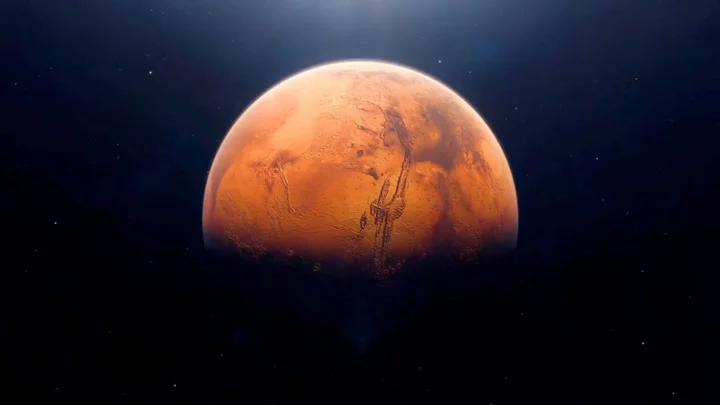
Perseverance rover captures stunning blue sunset on Mars
Mars is often called the Red Planet, but a recent image captured by NASA’s Perseverance rover from the surface would go some way to contradicting that. Earlier this year, Perseverance snapped a sunset from Mars in which the Sun looks blue, a sight which would never be seen from our own planet. The photograph was taken on the rover’s 842nd day on the planet, and shows a Martian horizon with the sun setting behind causing an eerily cool glow. Because of Mars’ distance from the Sun, it gets less sunlight than we do on Earth. Even at its sunniest, it gets less than half our quota of light from the star. And the planet’s atmosphere, which is weaker than Earth’s, is mainly made up of carbon dioxide, with a small amount of nitrogen and a trace of oxygen. This gaseous mix and weak atmosphere causes the light to scatter in a blue haze across the sky. It’s the same process which gives us our blue sky during the daytime, when the light has less atmosphere to penetrate before it reaches our eyes. On Earth, this changes when the sun dips below the horizon, and the light has more atmosphere to penetrate, filtering our blue and violet wavelengths, leaving only reds and oranges. Meanwhile on Mars, the sunlight interacts with the dust hanging in the atmosphere, scattering red light during the day. At twilight, that red light is filtered away, leaving blues. Atmospheric scientist Mark Lemmon of Texas A&M University told Science Alert: "The colours come from the fact that the very fine dust is the right size so that blue light penetrates the atmosphere slightly more efficiently. “When the blue light scatters off the dust, it stays closer to the direction of the Sun than light of other colours does. “The rest of the sky is yellow to orange, as yellow and red light scatter all over the sky instead of being absorbed or staying close to the Sun.” Sign up to our free Indy100 weekly newsletter Have your say in our news democracy. Click the upvote icon at the top of the page to help raise this article through the indy100 rankings.
2023-10-09 22:24

Hamas Israel attacks: The international victims of the assault on Israel
A number of those identified as dead or missing since Hamas launched attacks on Israel are from overseas.
2023-10-09 22:22

Should new tech rules apply to Microsoft's Bing, Apple's iMessage, EU asks
By Foo Yun Chee BRUSSELS EU antitrust regulators are asking Microsoft's users and rivals whether Bing should comply
2023-10-09 22:21

Fat Joe 'like kid in a candy store' hosting BET Hip Hop Awards
Fat Joe is hosting the BET Hip Hop Awards for the second year in a row. He couldn't be more thrilled, especially given that this year marks the 50th anniversary of hip hop.
2023-10-09 22:17

A New Translation of ’The Iliad’ Is Bringing a Truer Ancient Greece to Modern Readers
This all-new translation of the Homer epic is six years in the making.
2023-10-09 22:15

Skip Bayless Keeps Making His Wife Record Him Throwing Away the Same Cowboys Jerseys
VIDEO: Skip Bayless keeps throwing away Cowboys jerseys. Just stop buying them, bro.
2023-10-09 21:57

Retired Vermont university dean found shot to death on trail near campus. Now police are looking for her killer
A retired university dean was found shot in the head on a hiking trail near the Vermont State University Castleton Campus where she'd worked, and authorities are searching for whoever killed the beloved educator.
2023-10-09 21:49

Walgreens walkout: 5 things you need to know
Pharmacy staff at some Walgreens stores across the country say they will lock their gates and walk out Monday, citing harsh working conditions that make it difficult to safely fill prescriptions.
2023-10-09 20:47

Afghanistan earthquake: More than 1,000 dead as villagers dig for survivors
Villagers are searching through what is left of their homes with shovels and bare hands.
2023-10-09 20:26