

This is the reason why self-service checkouts are fitted with mirrors
With the increasing number of self-service checkout machines popping up in stores for convenience, there is one simple feature that is used to put off potential shoplifters - mirrors. There's a good chance that you've looked at your reflection in the screens fitted to these machines, and the purpose of it is for potential shoplifters to catch themselves in the mirror in the hopes of making them feel guilty. This pang of a guilty conscience is hoped to prevent them from committing any crime (it's not just there for vanity purposes like most of us use it for). Research also backs up the theory that people who see themselves in a mirror are less likely to do something bad. A 1976 study from Letters of Evolutionary Behavioural Science found that when people are around mirrors, they "behave in accordance with social desirability". "Mirrors influence impulsivity, a feature that is closely related to decision-making in both social and non-social situations." When participants in the experiment were looking at mirrors, their "private self-awareness was activated" by them and as a result influenced "decision-making as a non-social cues". Similarly, Psychology Today notes how a mirror allows "people to literally watch over themselves" and this "dramatically boosts our self-awareness". Meanwhile, the issue of self-service checkouts and shoplifting was highlighted in a report by Mashed last year which it appeared to confirm that Walmart's attempt at combatting this problem was a psychological method with the addition of mirrors (though Walmart, alongside other supermarkets, has never confirmed the purpose of their mirrors at their self-service checkout services). Sign up to our free Indy100 weekly newsletter Have your say in our news democracy. Click the upvote icon at the top of the page to help raise this article through the indy100 rankings.
2023-10-09 18:15
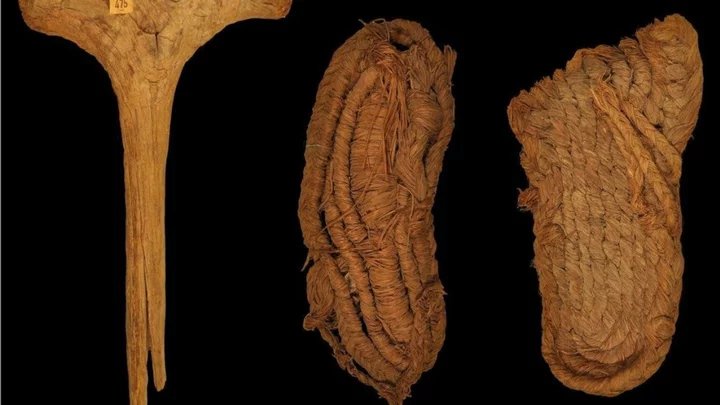
Prehistoric footwear dating back 6,200 years discovered in a Spanish cave
A pair of shoes thought to be the oldest ever found in Europe are now estimated to be even older than scientists had previously thought. About 20 pairs of sandals found in southern Spain are at least 6,200 years old, while other woven objects found in the cave date back 9,500 years, according to a new study. The scientists used carbon-dating on 76 objects found in the Cueva de los Murciélagos, Albuñol, near Granada, which were originally discovered by miners in the 19th century. The objects are particularly valuable to science because they represent the first direct evidence of certain hunter-gatherer skills, such as weaving, in southern Europe. They are made of wood, reed and esparto grass. The shoes measured about eight inches in length. The study was published in the journal Science Advances by a team from the Universidad de Alcalá (UAH) and the Universitat Autònoma de Barcelona (UAB). Francisco Martínez Sevilla, a researcher at the Prehistory Department of UAH, said: “These are the earliest and widest-ranging assemblage of prehistoric footwear, both in the Iberian Peninsula and in Europe, unparalleled at other latitudes. “The new dating of the esparto baskets from the Cueva de los Murciélagos of Albuñol opens a window of opportunity to understanding the last hunter-gatherer societies of the early Holocene. “The quality and technological complexity of the basketry makes us question the simplistic assumptions we have about human communities prior to the arrival of agriculture in Southern Europe.” He said the project placed the cave as “a unique site in Europe to study the organic materials of prehistoric populations”. Cueva de los Murciélagos, or “Cave of the Bats,” is located on the coast of Granada, to the south of the Sierra Nevada. The finds are thought to have been so well-preserved because of low humidity levels in the area. Study co-author María Herrero Otal added: “The esparto grass objects from Cueva de los Murciélagos are the oldest and best-preserved set of plant fibre materials in Southern Europe so far known. “The technological diversity and the treatment of the raw material documented demonstrates the ability of prehistoric communities to master this type of craftsmanship, at least since 9,500 years ago, in the Mesolithic period. “Only one type of technique related to hunter-gatherers has been identified, while the typological, technological and treatment range of esparto grass was extended during the Neolithic from 7,200 to 6,200 years before the present.” Sign up to our free Indy100 weekly newsletter Have your say in our news democracy. Click the upvote icon at the top of the page to help raise this article through the indy100 rankings.
2023-10-09 17:57

Futures down as Middle East conflict sparks run for safe-haven assets
U.S. stock index futures slipped on Monday as a growing conflict between Israel and the Palestinian Islamist group
2023-10-09 17:55

Irish-Israeli woman missing in Israel amid attacks
The Irish Department of Foreign Affairs says it is aware of the case and is in contact with the family.
2023-10-09 17:51

Xavi fumes with VAR after offside controversy in Granada draw
Xavi was livid with the decision to rule out a potential late winner in Barcelona's 2-2 draw with Granada.
2023-10-09 17:50

Hanshow's Latest Sustainability Report Maps a Greener Future with EPIIC Framework
BEIJING--(BUSINESS WIRE)--Oct 9, 2023--
2023-10-09 17:48

Broadband Forum Appoints New CEO
FREMONT, Calif.--(BUSINESS WIRE)--Oct 9, 2023--
2023-10-09 17:21

Logan Paul faces backlash after ‘only offering CryptoZoo victims 10 per cent compensation’
Influencer Logan Paul is under fire after allegedly only offering the victims of his cryptocurrency project, CryptoZoo, 5-10 per cent of their losses. CryptoZoo was a cryptocurrency game that Paul described as a "really fun game that makes you money", where he asked fans to invest by purchasing cryptocurrency collectables. However, a year later, no game materialised, with Paul apparently abandoning the project. Despite this, the CryptoZoo website still says it is "undergoing upgrades" and that "big things are coming!" At the start of 2023, YouTube investigator known as 'Coffeezilla' uploaded a crypto video titled 'Investigating Logan Paul's Biggest Scam', racking up over 9 million views. The video featured those who had invested in the game, individually listing off the amount of money they had lost from it, anywhere between $15,000 to $500,000. Initially, Paul threatened legal action against Coffeezilla for defamation, but days later apologised and said he would take accountability, with part of this including repaying investors. Nine months later, however, and those who requested a refund are still waiting for their money to be returned. YouTuber 'Kavos' has an alleged update on the situation, saying "reliable sources" are claiming that Paul's "best offer was 5-10 per cent of the losses suffered". Kavos went on to call it "an absolute disgrace", and added that "before this 'offer' Logan and his team tried to get the case dismissed. There is absolutely no accountability or sympathy for his actions." Many were outraged at Paul's actions, with one user writing "there's no rock bottom for him". Whilst another asked "is anyone surprised?" Saying Paul has never "shown an ounce of integrity": However, some were hesitant to criticise due to the ambiguity of Kavos' "reliable sources": Indy100 has reached out to Logan Paul for comment. Sign up to our free Indy100 weekly newsletter Have your say in our news democracy. Click the upvote icon at the top of the page to help raise this article through the indy100 rankings.
2023-10-09 17:20

China's Sept new yuan loans seen jumping on policy boost- Reuters poll
BEIJING China's new yuan lending is expected to jump in September after a surprising surge in August, a
2023-10-09 16:59

Colombian billionaire takes control of UK's struggling Metro Bank
Jaime Gilinski Bacal, a Colombian banking and real estate entrepreneur, has taken control of Metro Bank as part of a bigger rescue deal to fill a hole in the UK lender's finances.
2023-10-09 16:55

ECB's De Guindos sees inflation slowing down, but urges caution given growing uncertainty
MADRID (Reuters) -Inflation is expected to stay on its downward trend in the coming months, the European Central Bank's Vice-President
2023-10-09 16:51

Archaeologists have just found a rare 18th-century cold bath
Archaeologists have found a rare cold bath below the 18th-century Bath Assembly Rooms. The rooms, completed in 1771, were fashionable places of entertainment, conversation, dancing and gambling and cold baths were seen as good for people's health. The cold bath is in the centre of a suite of three rooms beneath one end of the ballroom. It has dressing rooms on either side. The excavation involved removing a later floor that had been installed over the cold bath and removing tonnes of rubble to reveal steps down into it. Bruce Eaton, of Wessex Archaeology, which oversaw the excavation, told the Guardian: “Although historical records indicated that there was a cold bath buried beneath the Bath Assembly Rooms, we had no idea what preservation of the bath would be like. “The building suffered damage at the hands of the Luftwaffe and the rooms were remodelled in the late 20th century but, after carefully excavating tonnes of concrete and rubble, we saw the original structure emerge in its entirety. “It’s tremendous to be able to piece together this rare archaeological evidence of an 18th-century cold bath with social historical accounts from the time.” Tatjana LeBoff, a project curator at the National Trust, said: “The cold bath at the assembly rooms is highly unusual. It is a rare, if not unique, surviving example, and possibly it was the only one ever built in an assembly room.” The trust was researching records, letters, diaries and other documents to discover more about the cold bath, she said. Sign up to our free Indy100 weekly newsletter Have your say in our news democracy. Click the upvote icon at the top of the page to help raise this article through the indy100 rankings.
2023-10-09 16:47