Germán ejected, Judge booed as allegations of cheating swirl around Yankees
New York Yankees right-hander Domingo Germán was ejected from a game against the Toronto Blue Jays after umpires checked his hands for banned sticky stuff
2023-05-17 08:53
The story of Silvio Berlusconi and the birth of the Champions League
A version of this story was published in February 2017 Diego Maradona was one of many players struck by the strange “uniqueness” of the occasion. He wasn’t to know the half of it. Because, the last and only other time that Napoli travelled to Real Madrid - back in the 1987-88 European Cup - it involved a hugely bad-tempered game that also saw a manager call a player a “mafioso” and took place in front of no fans and in an odd silence, due to crowd trouble the previous season from Real’s infamous Ultrasurs. It was hardly the setting for such a highly anticipated match between two heavyweights, not to mention the meeting of one of the greatest players ever and the most successful European Cup club ever. All of that will likely get replayed in the build-up to Napoli’s return to the Bernabeu on Wednesday, but none of it is what really makes that 1987 match unique. This was actually the game that changed European football. AC Milan owner Silvio Berlusconi was one of many watching, but he couldn’t share in the excitement around the fixture. He was aghast at the fact that two clubs like that could meet as early as the first round of the competition, as was happening here. It was hardly the stage to waste such a highly anticipated clash, or to waste one of the sides that would be eliminated but instead should have been making the competition all the more enticing later on. Berlusconi naturally feared the same could happen to his own club, but also had wider concerns. So, he set in motion his plans for a European super league. That didn’t happen, but the idea - and the threat - directly led to the creation of the Champions League, and the super-club-dominated era we have today. It is also a situation with several levels of irony. What is only the second ever tie between Real and Napoli is now seen as a novelty in a last-16 stage that has meetings of Barcelona-PSG and Arsenal-Bayern Munich both being replayed for the fourth time in just five years, a level of repetition that has dulled some of the Champions League’s intrigue and mystique. It was exactly the intrigue and a mystique of a rarely-played fixture coming in the competition’s old opening knock-out round, however, that led to that. What’s more, this growth of the Champions League has someway cannibalised some of those who were initially so behind super league ideas - from Rangers in Scotland to Liverpool and even Milan themselves. It’s certainly difficult not to wonder what Berlusconi now thinks about Milan’s meek drift away from the glamorous competition he helped create. You don’t have to wonder what Real and Napoli thought on being drawn against each other so early in 1987, though. They were stunned. Part of the reason was that the first-time Italian champions had no European pedigree, so were unseeded. Real’s pedigree was emphasised by the fact this was their 100th European Cup match at the Bernabeu, making it all the more incongruous that it would take place in front of the stadium’s empty stands. A two-game closed-doors order was the price for crowd trouble in the previous season’s semi-final against Bayern Munich. It was probably oddly fitting that the match that would prove so transformative for the quality, glamour and scope of the competition, however, was a poor game played in front of nobody. Described by Mundo Deportivo at the time as a “cold” occasion where the players were “orphaned” on the pitch, it did heat up between the teams. Both squads probably took Maradona’s demand to “go and batter them!” a bit too literally. Many kicks and apparently punches were traded, a bag of ice was thrown at Real manager Leo Beenhakker, and Napoli’s Salvatore Bagni later claimed the Dutch coach and some of his players had called him “mafioso”. Beenhakker did apologise for that before the second leg, again citing the “unique” circumstances of the game, but from the vantage point of a 2-0 victory. The goals summed up the level of performance. Michel scored from a penalty, Fernando De Napoli was responsible for an own goal, all to the sound of silence. Returning to Spain for the first since leaving Barcelona in 1984, Maradona had been marked out of the game, and blamed Napoli’s poor display on the pressure of a first appearance in the competition. “You don’t have to exaggerate,” he said. “We did not see the true Napoli, perhaps because of the responsibility of a debut in the European Cup.” It was exactly this kind of quirk, however, that so concerned Berlusconi. He just couldn’t see the logic in the competition’s best - and most televisually lucrative - teams potentially going out because of one bad night, one stroke of bad luck. It was precisely this Berlusconi feared for Milan, as he admitted in what would prove a hugely prescient interview with World Soccer in 1991. Amid predictions about the decline of international football and how European Union regulations would completely condition the continental game, the mogul came out with the following: “The European Cup has become a historical anachronism. It is economic nonsense that a club such as Milan might be eliminated in the first round. It is not modern thinking.” Berlusconi had shown a lot of very modern thinking, particularly by football’s conservative standards, since taking over Milan in 1986. Though always a fan of the club, he saw them as one arm of his business empire. Berlusconi made little secret of his plans to use both the Rossoneri brand and his media company Mediaset together to maximise both. Having already revolutionised broadcasting in Italy with the way his innovative approach to regional stations evolved into the country’s first national private TV station in Canale 5, he had similar plans for football. Berlusconi felt the sport was utterly wasting its potential in this area, and not at all reaching a potential pay-TV audience of millions and beyond. He thought it absurd that the biggest clubs in a sport that involved so many popular stadium events were not regularly meeting in glamorously lucrative matches. Martin Schoots is now a prominent European agent representing players such as Christian Eriksen, but was then a journalist primarily covering the three Dutch stars at Milan - Marco van Basten, Ruud Gullit and Frank Rijkaard - and was always impressed with Berlusconi’s approach when they met. “He was a visionary,” Schoots says,” and very clear and convinced about what developments would come. His philosophy was that football was a spectacle.” Or, as was put by some of those close to Berlusconi, “the television spectacular world-wide” - and the potential audience for his Canale 5. Making the European Cup a super league was not quite a new idea, though. That had actually been creator Gabriel Hanot’s initial plan for the competition in 1955 in order to better reflect “rightful” champions than the nuances of knock-out football, but proved impractical with the travel and communication of the time. Liverpool had also come up with a discussion document suggesting mini-leagues in 1978, around the time they were drawn against Nottingham Forest in the first round, and that had been revived in 1984. No-one, however, had gone for it with the same force or sense of structure to it as Berlusconi. this Super League was based on merit, tradition and television - and therefore it was a league for big television markets Alex Flynn After initial moves with Real president Ramon Mendoza were rejected, the Italian businessman decided to commission a blueprint for a ‘European Television League’ in 1988. The man who ended up with that commission was Alex Fynn, then of Saatchi and Saatchi. A huge football supporter, Fynn had already given a talk at an event for the Rothman’s Football Yearbook called a ’10-point blueprint for football’, suggesting exactly a European super league. It was subsequently printed in the Times, and word got around. “A few weeks later, I got a call from the head of our Italian agency,” Fynn tells The Independent now. “He said ‘here’s the job you always wanted: design a super league for Berlusconi.’ And the reaction? “My reaction? My reaction was my head was turned, I was flattered, and I did what I thought he wanted - not necessarily what football needed. So this Super League was based on merit, tradition and television - and therefore it was a league for big television markets. I think it had a league of about 18 clubs and certainly two each from England, Italy, Spain… that was the plan.” It was a plan initially rejected by Uefa, but had still done its job. The idea was out there, as was the underlying threat of a possible breakaway and possible changes were now on the table. “He decided to publicise it and use it as a stalking horse and catalyst to support his argument,” Fynn says of Berlusconi. “I think it went further than that. When someone like Berlusconi has a plan for a breakaway European super league, even Uefa had to sit up and take notice. The underlying threat was this businessman might have the wherewithal to do what he says. In theory, breakaways aren’t tangible, because they need the sanctioning of Uefa and Fifa. So maybe he realised that and maybe all he was doing was to produce the plan to affect some sort of change that would benefit his club and his commercial business - which of course it did.” Uefa fundamentally realised the dilemma between trying to keep the big clubs happy and keeping their structures intact, and thereby had to strike a balance, setting a dynamic that would lead to the current situation - but keep tilting one way. In the autumn of 1991, at an extraordinary Uefa congress, the then 35 members voted in new proposals, this time primarily put drawn up by Mendoza and former Rangers secretary Campbell Ogilvie. The quarter-finals would be replaced by a group stage, and league systems would be part of the competition for the first time. Even more important than that structural change, though, Uefa contracted the marketing company TEAM to sell it. The competition would the next season become the Champions League - to create what Fynn describes one of international sport’s two “supreme branded events” along with the NFL, right down to the distinctive classical anthem - an exclusive ‘family’ of corporate sponsors were signed up, and TV packages would be sold to the highest bidder, based on market share. Big clubs from the leagues with the largest TV markets would earn more and more money, accumulating more and more political capital Crucially, Berlusconi’s broadcasting model had properly permeated club football for the first time. The European game’s governing body had adopted many of its principles, as would the Premier League and many of the continents major clubs, bringing huge finances into the game - but also greater disparities than ever before. Big clubs from the leagues with the largest TV markets would naturally earn more and more money, accumulating more and more political capital, to the point more and more changes to the Champions League were inevitable. Finally, with two of this week’s fixtures offering the clearest examples in Barca-PSG and Arsenal-Bayern, we have the regular “television spectaculars” Berlusconi so envisaged. He probably didn’t envisage them, however, without Milan. That team he created, however, might still be the most influential in history. Because, just as they were changing football on the pitch with Arrigo Sacchi’s tactical ideas, the club were also changing football off it through Berlusconi’s economic ideas. And, if it was fitting that the first leg of the Real-Napoli tie was so off-putting given the change that would follow, it was equally fitting the return would give a sign of what was to come; what was capable - both in terms of the event, and the takings. This truly was the “television spectacular” Berlusconi desired. In front of a raucous 82,231 crowd at Napoli’s San Paolo stadium, and with Brazilian star Careca back in the team after injury, the revenge-driven home side finally did what Maradona demanded and “battered” Real in the right way. If only for 44 enticingly intense minutes. That Real team never got beyond the semi-finals, and were the very next season hammered 5-0 by Milan in a historic landmark of a game Defender Giovanni Francini had set the occasion alight by making it 2-1 after just after the half-hour, and Napoli could have added many more before Careca - of all people - missed a fine chance on 40. Within four minutes, Emilio Butragueno had scored the decisive goal. Real were through. If history regularly repeats itself, it’s interesting how so many of the same debates do, too. In the aftermath of that game, Maradona’s European pedigree was questioned, while Butragueno’s clinical brilliance was widely praised. Neither would actually end up winning the European Cup, as that Real team never got beyond the semi-finals, and were the very next season hammered 5-0 by Milan in a historic landmark of a game. At the time, though, Real were convinced they were on the brink. They even celebrated that victory in an unusually ostentatious manner. Beenhakker was remarkably moved to declare a mere first-round win - for a club that had then won the competition six times - as “a result for history”. It was to prove exactly that, but not in the way he imagined. The future could already be imagined from Napoli’s earnings from the game. They received 10,000 million lira due to both ticket and television sales, estimated at that point to be a world record. The die had been cast - and is still rolling. The Champions League continues to gradually change according to the preferences of big clubs, if at a somewhat glacial pace. “The big clubs never have enough money,” Fynn says. “That’s why you can never satisfy them, whatever changes you make.” Right now, what generally happens is that we see a lot of the same clubs, and a lot of the same fixtures in the latter stages of the competition - to the point Real and Napoli is again a novelty. It is thereby a fixture that will forever remain unique. Read More Pep’s future and Premier League charges – Where next for Man City after treble? How Pep Guardiola can become the undisputed greatest manager Man City fans feel let down by Uefa’s ‘shambolic’ organisation of Istanbul final Football rumours: Wilfried Zaha eyes move to Paris St Germain The sporting weekend in pictures Pretty Woman makes Pep Guardiola’s day as Julia Roberts hails Man City champions
2023-06-12 18:49
Tunisia's president urges aid to stem migration as European leaders visit
Tunisia's president is hosting the leaders of Italy, the Netherlands and the European Union for talks aimed at smoothing the way for an international bailout
2023-06-11 18:52
One dead, two injured after man attacks tourists near Paris Eiffel Tower
By Dominique Vidalon and Gilles Guillaume PARIS (Reuters) -One person died and two others were injured after a man attacked
2023-12-03 07:56
5 reasons the New York Knicks could end with a championship in 2024
The Knicks haven't won a title in more than 50 years but with one of their best rosters in decades, this could be the year they break through.
2023-09-25 22:28
Deco reveals plans for Lionel Messi "farewell game" at Barcelona
Barcelona sporting director Deco has revealed that the club intend to host a "farewell game" for Lionel Messi.
2023-10-23 03:16
Wilmer Flores draws bases-loaded walk for go-ahead run, Giants come back twice to beat Rockies 9-8
Wilmer Flores drew a bases-loaded walk in the eighth from Evan Justice to bring home the go-ahead run after Mike Yastrzemski hit a tying RBI single that inning, and the San Francisco Giants came back twice to beat the Colorado Rockies 9-8
2023-09-09 13:47
EV batteries will have to be 50% lighter in future, Stellantis tech chief says
MILAN Carmaker Stellantis aims to develop lighter electric vehicle batteries, cutting weights in half to improve sustainability, the
2023-09-08 20:56
What happened to xQc? Kick streamer reveals he went to doctor, concerned fans say 'try stretching and exercising'
xQc said, 'My shoulder clicks in, and when I do it again it doesn’t, so it’s like in place right'
2023-07-23 12:18
Just for fun, Toyota is developing an EV with a manual transmission
For those who find electric cars a bit boring, Toyota engineers are working on a realistic-feeling fake manual transmission as a possible feature.
2023-06-17 03:17
In his own words: Christian Horner on world champion Max Verstappen
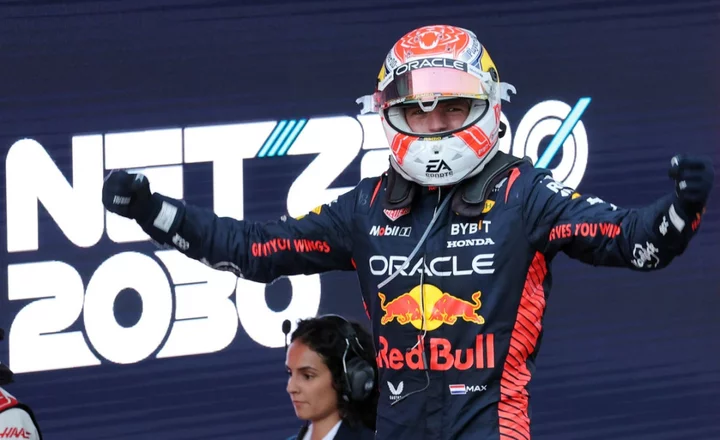
There had been a lot of talk about Max in karting. The first time I saw him was in his opening Formula Three race at Silverstone in 2014. I remember raising it to Helmut Marko – Red Bull’s motorsport consultant – that this kid looks the real deal. Helmut watched him at the Norisring in Germany and he was convinced. There was interest from Niki Lauda and Mercedes, but Red Bull could take him to Formula One immediately. So, he came to us a very young age. He was 16. And I remember in his very first outing for us – a demonstration run in Rotterdam – he took the front wing off the car! But you could tell in the seat fitting the confidence he had for a young guy was exceptional. All of the drivers that came through the junior categories learned their trade out of the spotlight, but Max became the youngest driver in Formula One ever. He was only 17. Every move and every mistake he made was scrutinised. Jean Todt, who was the FIA president at the time, changed the regulations to ensure someone as young and inexperienced as Max could not enter F1. There will never be a driver that moves so rapidly from karting to F1 again. But the way he dealt with it mentally made him a standout character. It was obvious in his first full F1 season when he drove for Red Bull’s sister team Toro Rosso, that he was an emerging talent, and at the beginning of 2016 he was performing beyond the capability of the car. Daniil Kvyat was struggling, and there was a lot of interest in Max. We made the decision to move him to Red Bull at the Spanish Grand Prix. Mercedes did their thing when Lewis Hamilton and Nico Rosberg crashed into each other on the first lap and Max, who started fourth which was already stunning, made the one-stop strategy work to win in his first Grand Prix with the team. He became the sport’s youngest ever winner, aged 18. It was a fairytale. Max had arrived. He won races in 2017 and 2018, and in 2019 he became the team leader following Daniel Ricciardo’s departure to Renault. He grew up, and it was a transformative year for him. In 2021 we had a car and an engine that could take the fight to Mercedes, and that season will go down as one of the most competitive sporting duels the sport has ever had. From the first race in Bahrain through to Abu Dhabi, Max and Lewis were like two heavyweights going up against each other. Max was a dog with a bone. He wouldn’t let it go. And you couldn’t script that they would head to the final race tied on points. Max was very cool. He put the car on pole, and we took our opportunity under the final safety car. Max had one lap to get the job done. I don’t think Lewis expected Max to attack in the corner that he did, and people overlook that he still had to beat Lewis. He still had to win the race. It wasn’t about two unlapped backmarkers. It was about Max reacting to the circumstances and getting the job done. And under the most intense pressure he did just that. He sent it down the inside and the whole place went bananas. To see him and his father, Jos, celebrate was a very special moment because it was the culmination of all the effort that his father had put into him at a very young age. Max achieved his goal, and anything after that was the icing on the cake, because for him, it was all about becoming a world champion. Max has still got all the tenacity he had when he got in the car as a 17-year-old, but he now marries that with experience. Outside of the car, he is a normal guy, too. He has his feet on the ground and he hasn’t had his head turned by fame and fortune. He still loves racing, and he has got good, grounded principals. He is competitive and wears his heart on his sleeve. He is very honest. He will give you everything, but he expects everything in return. He can go on to achieve so much more. We are riding a wave at the moment, and we want to continue riding that wave for as long as we can. Will Max be in Formula One for a long, long time? I don’t think so. He has ambitions beyond F1 and beyond racing. And at 26, 36 seems a long way away. We have a long-term agreement with him until 2028, and he has always said he will be happy to start and end his career here, but motivation will be a crucial factor. Read More Angry Lance Stroll shoves personal trainer and storms out of interview Max Verstappen fastest in Qatar practice as he closes in on world championship Fernando Alonso lauds Max Verstappen as best F1 driver since Michael Schumacher Fernando Alonso lauds Max Verstappen as best F1 driver since Michael Schumacher F1 Qatar Grand Prix LIVE: Sprint race updates and results at Lusail Max Verstappen hails third F1 world title as his best
2023-10-08 17:48
Does Paige Spiranac find Rick Shiels 'sweet'? Fans speculate if golf influencer and YouTube star are collaborating
'We always talk about it but we haven't done it yet. So Rick let's do it,' Paige Spiranac said
2023-06-23 21:46
You Might Like...
Escaped killer Danelo Cavalcante caught after two weeks
Kicker Brett Maher released by Los Angeles Rams after recent struggles; Lucas Havrisik signed
Why teachers in South Korea are scared of their pupils -- and their parents
Vikings safety Cam Bynum's wife hasn't seen a game in person. She needs a visa from the Philippines
Robert, Lynn star as White Sox beat Royals 5-2 for series sweep
Tesla to deliver Cybertrucks after Musk tempers expectations
Ecuador says vote to halt Amazon oil drilling a 'terrible precedent'
Bronny James plays piano, dines out in video, photos emerging days after he suffers cardiac arrest