
After the flood: The nightmare is just beginning for those left to rebuild after the Ukraine dam explosion
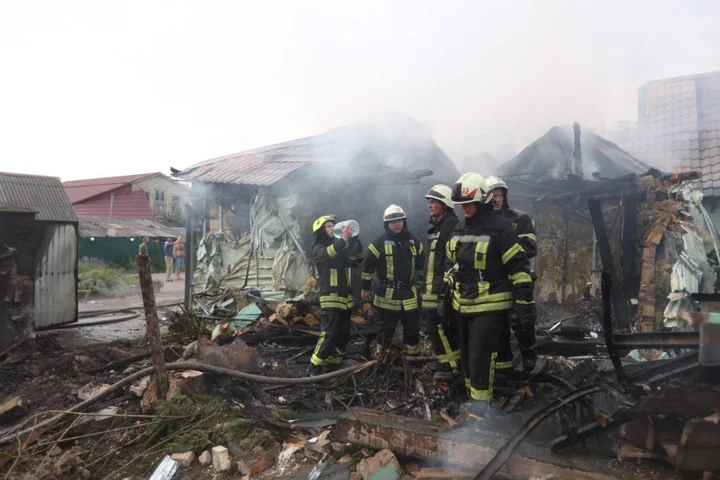
In a mud-soaked nightdress, the Ukrainian grandmother claws at the fetid water that has swallowed the steps down to her home in Kherson city. Frail and in shock, Antonia Shevchenko, 84 appears unaware of the futility of her attempts to try to drain the swamp drowning her house. Her daughter Svetlana, 64, marooned by the sweltering mud, tries to coax her to stop and calm down. Shelling roars in the background. It is the first time the pair have been back since they evacuated after the Nova Kakhokva dam blew up this month, unleashing the contents of one Europe’s largest reservoirs over southern Ukraine. The explosion - which Ukraine blames on Russia - sparked the worst ecological disaster on the continent in recent history and will likely impact global food security, according to the United Nations. In Kherson, the capital of the region, it killed dozens of people, submerged whole towns, drowned all the wildlife and turned this street into a canal. “We didn't even have time to get her clothes, we had to carry her in the slippers and nightie she is still wearing now,” says Svetlana in tears, as her confused mother repeats “It’s all just mud,” in the background. “It’s impossible to fix this. I feel nothing now. Everything is just empty inside. Now it’s all gone, we have nothing left," Svetlana adds. A few streets away Oksana Kuzminko, 70, who was also returning for the first time, picks her way through the devastation. “Welcome to zombie land,” she adds with a despairing shrug. Until recently the only way to navigate these streets was to steer a boat between the tops of the roofs of the submerged houses. Now the waters have receded, the terrifying scale of the damage and the work still to be done has been revealed. Sewage, mud, rubbish, dead animals, bits of masonry, and potentially land mines swirl together in the backyards of the partially collapsed houses. The area is still being pounded by Russian forces, stationed on the other side of the swollen banks of the Dnipro river. Anna Gatchecnko, 73, another elderly resident of this district, says the combination of flood waters and the war is “your worst nightmare”. “We survived the Russian occupation, the shelling and now this happened,” she says, wearing plastic bags she has tied to her feet in the toxic slush. “They took everything. My house, my belongings were the last things in this world that I had." The Kakhovka dam - essential for fresh water and irrigation in southern Ukraine - is located in a part of the Kherson region that Moscow illegally annexed in September and has occupied for the past year. The damage is so severe Ukraine has accused Russia of “ecocide” – believing Moscow’s forces blew it up in an attempt to prevent Kyiv’s troops from advancing in the south as they launched a counteroffensive. Moscow has vehemently denied the accusations and blamed Kyiv. Experts say the dam was so robustly built only an internal explosion could have caused such a catastrophic breach. The tearing floods have wiped out hundreds of towns and villages according to the United Nations, which has warned nearly a quarter of a million people have been left in need of drinking water. Downstream of the dam - towns and villages have morphed into polluted swamps where cholera has been detected. Upstream, the reservoir which once sustained swathes of agricultural land, has turned into a salty desert. Residents in those areas queue to get water from fire trucks under shelling. And the repercussions will be felt well beyond Ukraine’s borders, even potentially sparking global hunger. Ukraine - a major exporter of grains, oils and vegetables - was already struggling to export its harvest because of war. The ravages of flooding in one of the world’s most important breadbaskets will almost inevitably lead to lower grain exports, higher food prices around the world, and less to eat for millions in need. “The truth is this is only the beginning of seeing the consequences of this act,” Martin Griffiths, a United Nations aid official warned recently. It also raised fears about the stability Zaporizhzhia nuclear power plant, Europe’s largest, which relied on the waters of the now-dry Kakhovka reservoir to function. Rafael Grossi, head of the UN’s Atomic agency, which has unsuccessfully attempted to build a safety zone around the facility, was so concerned he travelled to the Russian-occupied plant. There he admitted it was "grappling with ... water-related challenges”. In Zaporzhizhia’s regional capital, Taras Tyshchenko, head of the Ministry of Health's Centre for Prevention and Disease Control, said if the Russians were capable of unleashing the waters over Kherson, they would have no qualms in taking out the nuclear power. After the dam's explosion, his health facility tests the air and waters across the region multiple times a day for radiation and contamination. So far they have detected cholera and remain on high alert for radiation. They have been through three rounds of training in the event there is a disaster at the nuclear power plant and have distributed potassium iodide tablets to those living within the danger zone. The damage from the destroyed dam is unfathomable, he says in front of the city’s main dock which is now dried out. The sweeping concrete jetty, which once hosted commercial water traffic, stoops forlornly over muddy puddles where his teams take water samples. “It could take well over a decade to fix the dam, refill the reservoirs and restore this region to normal," he adds grimly. "And that work can only really start after victory." In the interim cities, towns and villages along the Kakhovka reservoir will morph into wastelands if no solution is found. Deep fissures crisscross the cracked riverbeds where dead fish and molluscs slowly crisp in the sun. In one village, a forlorn fisherman drives a scooter across the desert scape in search of a pool of water. “Once the dam exploded we tried to build our own mini dams to try to retain some water, “ explains Vitaly Marozov, 29, who works at a 400-hectare farm producing vegetables and fruit just outside of the city of southern city Nikopol. He plays us a video of local volunteers building a makeshift barrier out of sacks and soil. “Now we are trying to dig wells but the water is salty," he adds. This is already destroying crops. Standing by a destroyed field of cabbages, dusted white with salt, he says they will be lucky if they can salvage a fifth of their total yearly yield. The damage he believes will cost their farm 22 million hryvnia, or around £500,000, and it will only get worse as the season progresses. “We are just one farm, this is the case all around this area. This will impact global food security unless someone does something drastic,” he continues. Back in the water-logged regions, volunteers deliver aid by boats to the communities now cut off from help. Others bring pumps to try to drain the pools of stagnant water from the worst-hit areas. But all it does is expose the irreparable damage done to the entire southern sweep of Ukraine. We find Olha Mosyk, 70, who was forced to swim to safety with a litter of newborn kittens, islanded by destruction in her home in the Mykolaiv region. Sodden muddy piles of dirt mark the remains of the walls of her house. “You need steel teeth to break Ukrainians. That won’t work on me,” she says, pulling up the remains of rotten potatoes from her destroyed field which is the same tyranny of blackened mud. “All we can do is try to pull ourselves together,” she adds with a pause. Back in Kherson city, Svetlana tries to comfort her mother Antonia who is on the cusp of a panic attack. “How do I feel? Crying all the time. My whole body is shaking,” the 84-year-old says faintly, her red floral nightie a flash of colour in the grey water. “It’s all flooded. My whole life is underwater.” Read More Zelensky accuses Russia of plotting ‘radiation leak’ attack at Zaporizhzhia nuclear plant Ukraine's president tells other countries to act before Russia attacks nuclear plant Ukrainian soldiers rescue Russian troops left to drown after Kakhovka dam destruction Russia-Ukraine war live: Moscow ‘arrests General Armageddon’ over Wagner rebellion Recapping the revolt in Russia, through the words of 4 presidents and a mutinous warlord
2023-07-03 23:22
Geologists have figured out how to locate diamond ‘explosions’
A group of geologists has recently achieved a breakthrough in identifying potential sites for the formation of diamonds. Diamonds, the hardest naturally occurring material we have found, originate under the extreme conditions of immense pressure and high temperatures deep within the Earth's interior. These precious gems are occasionally pushed to the surface in molten rock formations known as kimberlite. However, there are currently two competing theories regarding what is responsible for this rush of kimberlite which brings diamonds to the surface. In a recent study, these theories were closely examined by a research team. In a piece for The Conversation study author and Associate Professor in Earth Science at the University of Southampton, Thomas Gernon explained: “one proposes that kimberlite magmas exploit the ‘wounds’ created when the Earth’s crust is stretched or when the slabs of solid rock covering the Earth - known as tectonic plates - split up.” “The other theory involves mantle plumes, colossal upwellings of molten rock from the core-mantle boundary, located about 2,900km [1,802] beneath the Earth’s surface.” However, neither of these theories adequately explains how magma manages to find its way through the Earth's crust, or the specific composition of the resulting kimberlite. By employing statistical analysis and machine learning, the team analysed the breakup of continents and its correlation with kimberlite formation. Their findings indicated that the majority of kimberlite volcanoes erupt 20 to 30 million years after tectonic breakup. “It also added a major clue,” Gernon explained. “Kimberlite eruptions tend to gradually migrate from the continental edges to the interiors over time at a rate that is uniform across the continents.” Delving deeper into their investigation through computer-generated models, the team ultimately concluded that diamond eruptions stem from a "domino effect." As continents gradually drift apart from each other, they generate rifts of thinned crust. As this happens, regions of thick, cold rock descend into the hot magma beneath, inducing an upsurge of the mantle, which in turn triggers a similar flow in nearby continents. Gernon elaborated on the team's findings, saying, "Various other results from our computer models then advance to show that this process can bring together the necessary ingredients in the right amounts to trigger just enough melting to generate gas-rich kimberlites,” Gernon explained. “Once formed, and with great buoyancy provided by carbon dioxide and water, the magma can rise rapidly to the surface carrying its precious cargo.” Moreover, the same methodology could potentially be employed to locate diamonds and other rare elements. “The processes triggering the eruptions that bring diamonds to the surface appear to be highly systematic,” Gernon siad. “They start on the edges of continents and migrate towards the interior at a relatively uniform rate.” The study is published in the journal Nature. Sign up to our free Indy100 weekly newsletter Have your say in our news democracy. Click the upvote icon at the top of the page to help raise this article through the indy100 rankings.
2023-08-31 00:25
Chargers need to find a way not to allow second-half rallies
Brandon Staley and the Los Angeles Chargers coaching staff go into the bye week with many things to assess
2023-10-03 09:25
Djokovic into seventh French Open final as Alcaraz hit by injury
Novak Djokovic reached his seventh French Open final in dramatic and controversial circumstances on Friday when world number one Carlos Alcaraz suffered serious...
2023-06-10 00:51
The White House picks West Virginia and the Philadelphia region for hydrogen hubs, a source tells AP
The White House has selected the Philadelphia area and West Virginia for two regional hubs to produce and deliver hydrogen fuel, which is an important part of the Biden administration's clean energy plan
2023-10-13 02:27
Zac Gallen dares to doubt the power of Wawa before NLCS Game 1
Zac Gallen grew up in south New Jersey -- so right outside of Philadelphia, sort of -- and he's very concerned with the state of Wawa.
2023-10-17 04:25
Nepal retrieves bodies of six killed in helicopter crash
By Gopal Sharma KATHMANDU (Reuters) -Authorities in Nepal have retrieved the bodies of all six people killed in a helicopter
2023-07-11 21:15
Russia accuses US of 'destructive' approach on Israeli–Palestinian war
By Guy Faulconbridge MOSCOW (Reuters) -Russia condemned violence against both Jews and Palestinians in Israel and the Palestinian Territories on
2023-10-09 21:54
Three Zion Williamson Trade Destinations
If Zion Williamson gets traded, where could he go?
2023-06-14 22:51
Is 'The Flash' director Andy Muschietti directing the next Batman film? Warner Bros lends director support
Andy Muschietti directed 'It' and 'It Chapter Two' for Warner Bros that amassed close to $1.2B at the box office worldwide
2023-06-13 08:55
Jake Paul gets trolled by KSI over leaked private messages, fans call for a 'fight' between the two
MMA fighter Dillon Danis leaked private DMs from Jake Paul's coach, Shane Mosley, and KSI trolled the YouTuber over it
2023-08-04 17:00
'The world needs you,' Biden tells Air Force graduates
COLORADO SPRINGS U.S. President Joe Biden warned graduates of the Air Force Academy that they will face an
2023-06-02 01:50
You Might Like...
Shoppers say they want sustainable goods, but won't pay more
Huge bears raid Krispy Kreme and help themselves to doughnuts
FanDuel + DraftKings College Football Promos: $400 GUARANTEED Bonus for Your Week 1 Parlay!
Australia's central bank says hike this week due to inflation risks, warns more may come
North Korea says interference in its satellites would be declaration of war
‘My body was burning’: Russian journalist’s horror journey in grips of suspected poisoning
Minnesota becomes 23rd state to legalize recreational marijuana
Golden Knights' Shea Theodore finds rhythm at right time to start Stanley Cup Final